

Seeing a lower number next to a wall of five-star reviews feels contradictory. It is not. Public ratings tell part of the story, while the Success Score evaluates the order experience across a wider set of signals. Fiverr describes the score as deliberately stable and based on longer-term performance, so a change may reflect a pattern that is not obvious from the latest review on your profile.
Checked August 16, 2026. This guide uses Fiverr’s current Success Score and freelancer level help pages. It does not claim to reveal Fiverr’s formula, identify the exact order behind a change, or predict when a score or visibility will recover.
A 5-star profile and a lower Success Score can coexist
Fiverr treats rating and Success Score as separate performance metrics in its level system. The rating metric reflects the average ratings from clients you worked with during the past two years. The rating displayed on your profile reflects your all-time ratings. The Success Score, by contrast, is built from the scores of your individual Gigs and evaluates several parts of the order process.
That distinction explains the apparent mismatch. A public five-star average does not show every input Fiverr says it evaluates. The Success Score uses quantitative data, such as statistics and scores, and qualitative data, such as feedback and reviews. It also covers communication, conflict, cancellations, delivery time, and whether clients felt they received value for money.
This does not mean a hidden complaint definitely caused your drop. It means five-star reviews cannot prove the score had to stay unchanged. Fiverr does not publish an order-by-order explanation or a complete weighting formula.
Gig score versus overall score
Your overall Success Score is not a simple average of your public reviews. Fiverr says it considers the individual scores of all your Gigs. Gigs with more orders carry more weight in the overall score. It also says higher-value and more recent orders may have a greater impact on a Gig score.
Start at the Gig level. One busy Gig with a negative impact area can matter more than several quiet Gigs that show no obvious problem. The reverse is also possible: a strong high-volume Gig may carry much of the positive weight. Fiverr does not provide enough detail to calculate either effect yourself.
| View | What it represents | What you can check | What it does not prove |
|---|---|---|---|
| Public rating | The profile rating clients can see | Visible reviews and the displayed average | That every Success Score input is positive |
| Gig-level score | Performance of one Gig across Fiverr’s evaluation areas | Score and strongest impact areas in Level Overview | Which exact order changed the score |
| Overall Success Score | A weighted result based on individual Gig scores | Current number and change over time | The formula or exact weight of an order |
| Freelancer level | The level shown to clients | Current criteria, grace notice, and benefits | A guaranteed number of impressions or orders |
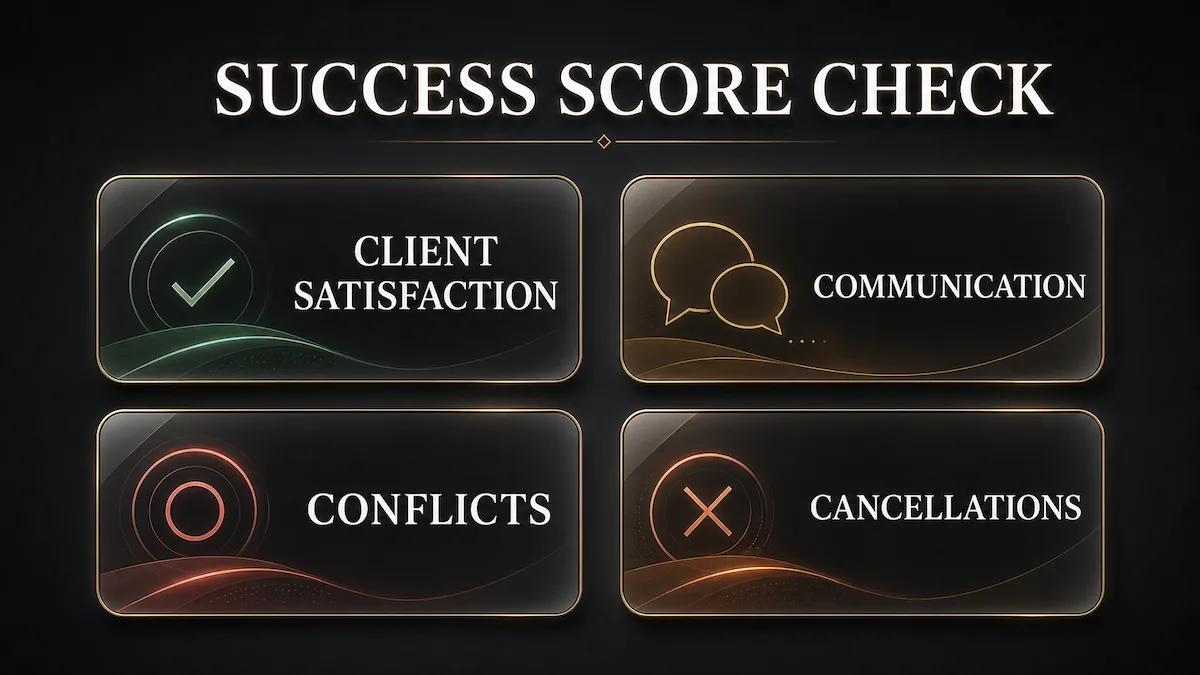
The six areas Fiverr documents
Fiverr groups Gig performance into six areas. Use these as audit categories, not as a list of accusations. A negative label tells you where to inspect your process. It does not tell you which buyer or order produced it.
| Evaluation area | What Fiverr describes | Evidence worth reviewing |
|---|---|---|
| Client satisfaction | Reviews and other statistics that reflect happiness with the overall order experience | Requirements, delivered scope, revision requests, feedback, and the final exchange |
| Effective communication | Responsiveness, helpfulness, clear expectations, and project updates | First response, unanswered questions, promised updates, and timeline changes |
| Conflict-free orders | How often disputes and issues arise during an order | Escalations, repeated objections, scope arguments, and attempts to resolve concerns |
| Order cancellations | The effect of cancellations on the order process | Who requested cancellation, the stated reason, and what happened before it |
| Delivery time | On-time or early delivery, including the frequency of late deliveries | Due dates, extension requests, accepted changes, and actual delivery times |
| Value for money | Whether clients felt they received the value they paid for | Package promise, price, delivered items, and complaints about usefulness or quality |
What can make the score drop
Fiverr’s Success Score page names six broad causes: lower ratings or negative feedback, consistently late delivery, a high rate of cancellations, ineffective or slow communication, frequent disputes or conflicts, and clients feeling that the service did not meet their value expectations.
The wording matters. These are documented factors, not a tool for identifying a single culprit. A recent cancellation may be relevant, but you cannot conclude that it caused the change or determine how much it counted. The same limit applies to a late order, a difficult exchange, or feedback that you suspect was negative.
The score also uses a longer evaluation period. Fiverr says this is intended to produce a stable view of performance and prevent one order from having too much impact. A score change can therefore lag behind the event you are looking at, combine several areas, or reflect the weighting of a busier Gig. Fiverr does not publish enough information to separate those possibilities.
What not to assume
- No new orders did not lower the score by itself. Fiverr says inactivity or a lack of new orders does not by itself reduce the Success Score.
- An unresponsive buyer does not count against the score. Fiverr says the level system accounts for unresponsive clients.
- A revision or extension is not automatically negative. Fiverr says revisions, delivery extensions, and partial refunds are evaluated by how they affect the overall client experience.
- A score of 10 is not required for success. Fiverr also says performance is assessed relative to other freelancers in your price range.
- Five stars are not a guarantee. Reviews matter, but they sit inside a broader assessment and the rating is a separate level metric.
Avoid making a defensive change based on a guess. Do not close a healthy Gig because you assume it is dragging down the account. Do not pressure clients for feedback, offer refunds without a real service issue, or turn every order into a stream of anxious messages. Audit first.
Level consequences and the 30-day grace period
A lower Success Score matters differently depending on your current level and the rest of your metrics. Fiverr’s current criteria require a Success Score of at least 5 for Level 1, 7 for Level 2, and 9 for Top Rated. Rating, response rate, completed orders, unique clients, and earnings also apply. Top Rated status includes an additional manual evaluation.
If your performance falls below the criteria for your current level, Fiverr says you enter a 30-day grace period. Level 1 and Level 2 freelancers who do not improve the relevant stats during that period move to the level that matches their current metrics. Top Rated freelancers are reviewed to decide whether they remain Top Rated or move lower.
The 30 days are a level grace period, not a recovery promise. Fiverr does not say your Success Score will update by a certain day, identify the number of orders needed, or guarantee that a process change will preserve your level.
Fiverr separately says that a critically low Success Score can lead to a low-performance label and affected visibility. It does not quantify the visibility change or publish a restoration timetable. A normal decline is therefore not proof that every Gig has disappeared from search.
What buyers can see
Only you can see your Success Score. Clients see your freelancer level on Gig cards, Gig pages, and your profile. A level change can remove access to some benefits. Fiverr also says advancing levels can increase the chance of receiving orders, while making clear that level is only one of many factors affecting order volume.
Keep those claims separate. Fiverr documents that critical low performance affects visibility. It does not say that every one-point drop causes a specific ranking loss. If impressions or orders also declined, record that as a separate observation rather than treating it as proof of the cause.
A practical evidence audit
The useful response is a dated audit you can repeat. It will not reveal the algorithm, but it can show which operating habit deserves attention.
- Capture the current dashboard. Save the date, overall Success Score, current level, every Gig score, and any grace-period or low-performance notice. Use screenshots for your own record.
- Expand Scores by Gig. Fiverr says this view shows which evaluation areas have the strongest positive and negative impact. Record the wording exactly. Do not translate an area label into an assumed buyer or order.
- Prioritize by activity. Review the Gigs with the most orders first because Fiverr says they carry more overall weight. Note recent and higher-value work too, since Fiverr says those orders may matter more to a Gig score.
- Build an order timeline. For the relevant Gigs, list due date, actual delivery date, extensions, cancellations, revision rounds, conflict points, and messages where expectations changed. Keep facts separate from your interpretation.
- Compare promise with delivery. Put the Gig package, buyer requirements, delivered files, and final response side by side. Check whether scope, timing, communication, and perceived value could have been clearer.
- Choose one process correction. Tighten requirements, set a realistic deadline, send fewer but more useful updates, clarify revision limits, or revise package scope. Pick the correction supported by your audit, not the one that feels most urgent.
- Keep a change log. Record what you changed and when. Watch the Gig-level impact areas and your operations. Do not assign a recovery deadline that Fiverr has not published.
Compact audit worksheet
| Field | Record |
|---|---|
| Audit date | Dashboard date and timezone |
| Overall state | Success Score, level, and any notice |
| Gig state | Gig score and strongest positive or negative areas |
| Order facts | Requirements, due date, delivery, extensions, revisions, cancellation, and conflict |
| Service comparison | What the package promised versus what the client received |
| Process change | One specific correction, owner, and start date |
| Unknowns | Exact order attribution, formula, weight, and update timing |
When the problem belongs in another workflow
A Success Score audit is not an appeal or dispute route. If a buyer specifically claims your delivery was generated by AI, use the Fiverr AI delivery dispute steps and preserve that order’s evidence. If Fiverr sends a separate restriction or suspension notice, move to the Fiverr suspension appeal guide. If the notice asks for identity documents, follow the Fiverr identity verification workflow.
Do not merge those issues into a Success Score theory. A lower score does not prove policy enforcement, identity trouble, or a payout restriction.
Official Fiverr sources
- Fiverr Help Center: Success score. Used for score calculation, Gig weighting, evaluation areas, documented drop factors, exceptions, relative comparison, and low-performance visibility.
- Fiverr Help Center: Understanding Fiverr’s freelancer levels. Used for level criteria, the 30-day grace period, demotion rules, visible level, and level benefits.
The most defensible next step is modest: inspect the Gig-level impact areas, match them to dated order evidence, and fix the clearest recurring process problem. Anything more precise would require information Fiverr does not publish.
Reader discussion
0 approved comments
Share a specific question, correction, or first-hand workflow detail. Do not include private financial or identity information.