

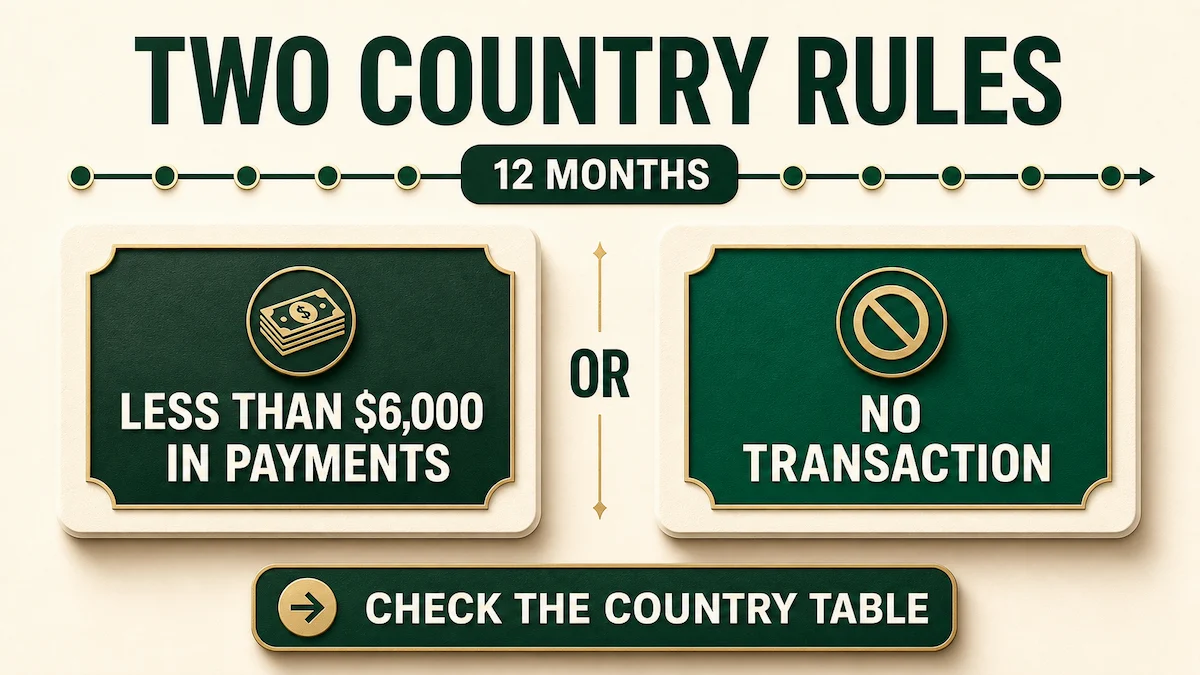
When does Payoneer charge the $29.95 Annual Account Fee in 2026? The rule depends on the country attached to the account and what happened during the relevant 12 month period. Payoneer publishes a payment threshold for countries affected by its updated criteria and a transaction test for remaining countries. Check the country table before assuming which rule applies.
That difference matters. Advice that is correct for one country may be wrong for another, even when the fee has the same name and amount. Start with the country table on Payoneer’s official Annual Account Fee page. For an account in an affected country, Payoneer says the updated criteria will also be reflected on the account’s Fees page from the effective date, if applicable.
When Payoneer charges the annual account fee
| Account group | Published 12 month test | Where to verify it |
|---|---|---|
| Countries affected by the updated criteria | Payoneer says the fee is charged if 12 months pass and the account has received less than $6,000 USD, or the equivalent, in payments. | Choose the relevant country in Payoneer’s table and check its effective date. Payoneer says the updated criteria will also appear on the account’s Fees page from that date, if applicable. |
| Remaining countries | Payoneer says the fee is charged if 12 months pass without at least one transaction in the account. | Use Payoneer’s country table rather than assuming the $6,000 test applies. |
The wording above is important. Payoneer does not publish one universal activity test for every account. Its help page also does not define every possible transaction type in that short explanation, so do not assume that moving money in a particular way will count. If you cannot tell whether a type of activity counts, ask Payoneer Support to confirm it before relying on it.
Choose the correct country first
For an individual Payoneer account, the official table says to select the country of residence. For a company account, select the country of the business. Do not choose a country based on a client, freelance platform, receiving currency or bank account unless it is also the country Payoneer tells you to use for that account type.
When we checked the table on 5 August 2026, the $6,000 payment test and an effective date of 23 February 2026 appeared for the countries listed as affected, including Argentina, Brazil, Egypt, Lebanon, Mexico, Nigeria, the Philippines, Turkey and Vietnam. This is a dated snapshot, not a permanent promise. Payoneer can update the table. For an affected country account, Payoneer says the updated criteria will be reflected on the Fees page from the effective date, if applicable.
How to check or avoid an unexpected annual fee
- Confirm the account country. Use residence for an individual account or business country for a company account, following Payoneer’s instructions.
- Open the official country table. Check whether your country uses the $6,000 in payments test or the at least one transaction test, and note any effective date.
- For an affected country, check the Fees page. Payoneer says the updated criteria will be reflected there from the effective date, if applicable.
- Review the relevant 12 months. For a country using the payment threshold, compare the payments received with Payoneer’s published $6,000 USD or equivalent test. Do not substitute lifetime receipts or a calendar year total unless those happen to match the period Payoneer is assessing.
- Check the exact transaction label. A charge with another name needs the fee rule attached to that label. The amount alone does not prove it is the Annual Account Fee.
Take screenshots of the transaction label and the relevant country table row if the records do not line up. For an affected country account, include the Fees page if the updated criteria appear there. Remove account numbers, customer IDs and other sensitive details before sharing them outside Payoneer’s support channel.
If $29.95 has already been charged
Start with the entry in Payoneer’s transaction history. Record the exact label, amount, currency and date. Then compare that information with the country rule that applied on the assessment date. For an affected country account, also compare any updated criteria shown on the Fees page, if applicable.
If the charge appears inconsistent with the published rule, contact Payoneer Support and ask for an account specific explanation. Provide the country used for the account, whether it is individual or company, the charge date and the relevant activity or payment total. Payoneer’s public help page does not promise a refund, so a support request should ask for a review rather than assume a particular outcome.
The public Annual Account Fee article also does not explain every collection scenario for an account with a zero or very small balance. Avoid treating community reports about negative balances, later deductions or account closure as universal policy. Ask Support how the fee is handled on your account if that detail changes your decision.
Do not mix the Payoneer fee with a platform payout fee
A marketplace can charge for sending a payout, while Payoneer can apply fees under its own account terms. Those are separate layers of the route. If you receive marketplace earnings through Payoneer, identify the platform charge and the Payoneer charge independently before calculating the cost.
For Fiverr, our comparison of Fiverr payout methods, fees and timing covers the platform side of the route. If a payout also involves currency conversion, use the amount that arrived to measure the exchange rate spread separately. A visible $29.95 annual fee should not be folded into the FX rate or mistaken for a withdrawal fee.
Common questions
Is the Payoneer annual account fee always charged after 12 months?
No single condition applies everywhere. Payoneer publishes a $6,000 payment test for affected countries and an at least one transaction test for remaining countries. Use the country table to identify the published rule. For an affected country account, the updated criteria may also appear on the Fees page from the effective date, if applicable.
Does one payment prevent the fee?
Not necessarily. In a country using the $6,000 test, Payoneer’s wording looks at the total received in payments during 12 months, not simply whether one payment arrived. For a remaining country, the published test refers to at least one transaction. Because the help page does not define every transaction type there, verify uncertain activity with Support.
What payment threshold does Payoneer publish for affected countries?
The current official page we checked uses less than $6,000 USD, or the equivalent, received in payments during 12 months for countries affected by the updated criteria. Use the current country table and effective date for the account.
Does an empty account avoid the fee?
Payoneer’s public Annual Account Fee page describes the charging criteria but does not provide a complete explanation for every zero balance collection scenario. Use the country table to identify the published criterion, then ask Support how collection is handled on the account.
Can Payoneer refund the annual account fee?
The public source cited here does not promise a refund. If the charge appears inconsistent with the account’s published fee condition, request a review and provide the supporting account records.
Before your next payout
Check the Annual Account Fee rule before sending another platform payout to a lightly used Payoneer account. That does not mean the route is automatically expensive or unsuitable. It means the annual fee belongs in the route calculation alongside the platform payout charge and any conversion cost.
If you are comparing a marketplace bank route with an international transfer, our local bank versus wire transfer guide shows how to keep platform, bank and intermediary costs separate. Use the same method here: identify the fee owner, the rule, the time period and the currency before comparing options.
Official source
- Payoneer: Annual account fee, fee amount, country dependent criteria, country selection, effective dates and Fees page guidance. Checked 5 August 2026.
Fees and account criteria can change. This guide explains the published rule and does not guarantee a refund, fee waiver or account outcome.
Reader discussion
0 approved comments
Share a specific question, correction, or first-hand workflow detail. Do not include private financial or identity information.