
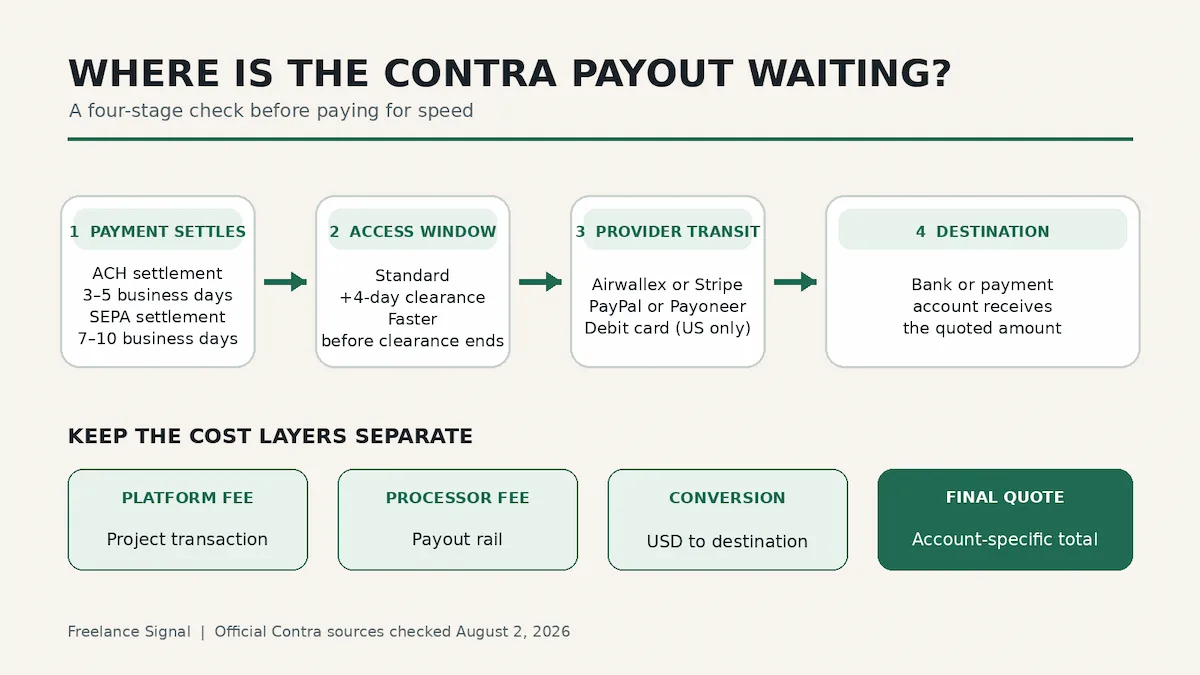
If a Contra payout looks slower or more expensive than expected, first identify which stage you are seeing. A client payment may still be settling, a Standard payout may still be inside Contra’s four-day safety clearance, or the payout provider may still be moving the money. These are different delays.
The same distinction applies to cost. Contra publishes platform fees, processor fees and currency-conversion fees separately. Combining them into one universal “Contra fee” produces the wrong answer for many accounts.
Standard vs Faster payout times
Contra publishes the following arrival ranges. The Standard column includes the four-day safety clearance. Faster payout gives access before that period is complete, but the provider’s own transit time still applies.
| Payout route | Faster payout | Standard payout |
|---|---|---|
| Bank account via Airwallex | 0–3 business days | 4–7 business days |
| Bank account via Stripe | 2–5 business days | 6–9 business days |
| Debit card, US only | Within one hour | Four business days |
| Payoneer | Within 30 minutes | Four business days |
| PayPal | Within 30 minutes | Four business days |
These are published ranges, not guarantees for a specific withdrawal. The route shown in your account controls which row matters.
There may be a delay before you can withdraw
The table starts at payout. It does not include the time a client’s bank payment needs to settle before the money becomes withdrawable.
- ACH payment: Contra says settlement takes three to five business days.
- SEPA payment: Contra says settlement takes seven to ten business days.
This means a Standard payout funded through SEPA can involve two separate waits: settlement first, then the payout’s safety-clearance and provider timeline. Choosing Faster payout affects the second part, not the first.
Four cost layers to keep separate
- Platform fee: Contra publishes transaction-based tiers for Free and Pro accounts. This is tied to the project payment, not the later choice of payout rail.
- Payout processor fee: Stripe, Airwallex, PayPal, Payoneer or Coinbase may charge for moving the funds. Contra says the fee shown depends on the payout account type, location and destination currency.
- Currency conversion: Contra says funds are paid in USD. A payout to a non-USD account is converted by the payment processor.
- Downstream cost: A receiving provider or bank may have its own account-level rules. Do not treat Contra’s table as proof that no later deduction can occur.
Contra’s public pages checked for this guide do not state one universal Faster-payout fee. Compare the final amount on the confirmation screen instead of assuming Faster is free or always costs a fixed percentage.
Published local-bank examples
| Destination | Published local payout fee | Published conversion entry | What to verify |
|---|---|---|---|
| Bangladesh, BDT | USD 1.50 | BDT falls under “all other currencies”: 1% | Final converted amount and any account-specific charge |
| Philippines, PHP | USD 1.50 | 0.40% | Whether the account shows PHP local payout and the final quote |
| Philippines, USD | USD 7.00 | No conversion should be assumed from the label alone | Account route, receiving currency and final amount |
| Egypt, EGP | 1.00% | EGP falls under “all other currencies”: 1% | Whether both components appear separately in the live quote |
The Egypt entries illustrate why the confirmation screen matters. The official table lists a percentage for the local payout and another percentage for currencies outside its named list, but the page does not show a worked Egypt example. Do not promise a combined percentage until the withdrawal quote shows how the account is charged.
Why the published components should not be added blindly
Contra lists the local-payout and currency-conversion entries separately but does not provide a worked all-in example or define a common calculation base for every route. Do not turn the Bangladesh, Philippines or Egypt entries into a promised total percentage. Compare the withdrawal quote with a neutral benchmark using the payout exchange-rate spread method, and record any processor fee separately.
Which option should you choose?
Choose based on the delay you can actually remove
- If the client’s ACH or SEPA payment is still settling, Faster payout cannot make those funds withdrawable immediately.
- If the funds are available and the four-day Standard clearance is the problem, compare the Faster quote with the value of receiving the money sooner.
- If the payout already left Contra, use Contra’s published transit range for that provider before treating it as late.
Compare the amount received, not just the headline fee
Write down the amount in your Contra balance and the amount the destination account is expected to receive. Check the fixed processor fee, conversion percentage, destination currency and any fee shown specifically for Faster payout. A method with a low fixed fee can still be expensive if its conversion is weak.
If the payout is delayed
- Check whether the client’s payment is still inside the ACH or SEPA settlement period.
- Confirm whether you selected Standard or Faster payout.
- Match the payout provider with the correct arrival range in the table above.
- Look for a Contra review message. Contra says some payouts may be placed on hold for fraud-prevention review.
- If the account is under review, Contra says it will send an email when funds are available. It aims to finish reviews in less than 24 hours, though some take longer.
- After the relevant range passes, contact Contra with the payout date, amount, route and destination currency. Do not publish account numbers or identity documents in a public forum.
Bottom line
Faster payout removes Contra’s four-day Standard clearance from the access path. It does not remove client-payment settlement, provider transit, conversion or a possible review. The useful comparison is the final amount and expected arrival shown for the route in your account.